
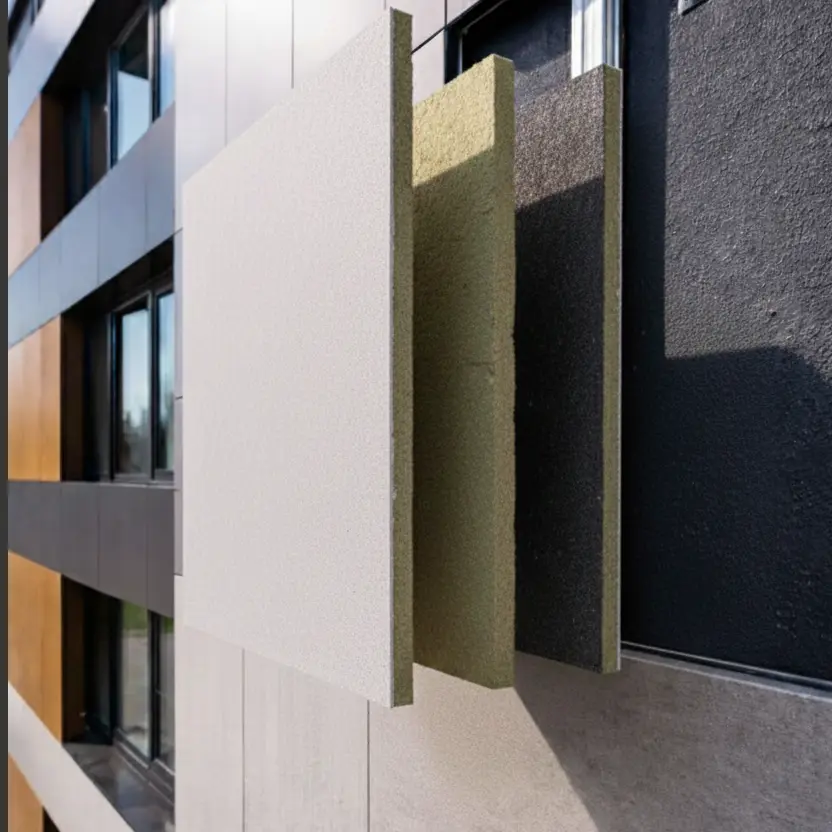
Facades are increasingly more than just a building’s cladding. They are becoming technical elements that must carry loads, provide thermal insulation, withstand weather and be suitable for prefabrication. This is where PET foam comes into play — a material well known in the composites industry but still considered a novelty in construction.
In this article we look at the real possibilities of using PET foams in facades and elevation panels. No marketing simplifications — instead a focus on practice, limitations and the situations where this material truly makes sense.
- Why PET foam in facades is being discussed at all
The way facades are designed and built is clearly changing. Prefabrication, fast installation and reducing thermal bridges play an ever-greater role. The classic assembly of supporting rails, insulation and cladding put together on site increasingly proves too complicated and hard to control in terms of quality.
At the same time the requirements for the facade panels themselves are rising. Panels must be lightweight, stiff, dimensionally stable and weather resistant. Thermal insulation alone is no longer enough. It increasingly matters whether a facade element can carry loads, maintain geometry and perform without deformation for many years.
In this context PET foam emerges — not as a direct replacement for EPS or mineral wool, but as a structural-insulating core. A material that combines insulation with load-bearing capacity and allows building facade panels as finished, prefabricated elements.
This is not a new technology, rather a transfer of proven solutions from industry and composites into construction. That’s why PET foam in facades is coming up again in conversations among architects, facade system manufacturers and companies prefabricating panels.
- How PET foam differs from classic facade materials
In facades traditional insulating materials like EPS, XPS or mineral wool perform one primary function — they reduce heat loss. They are not designed to carry loads or stabilise the cladding. That’s why facades built with these materials require subframes, brackets and many point fixings.
PET foam operates on a different logic. It is a stiff material with high compressive and shear strength that can act as a structural-insulating core. In facade panels it not only insulates but also stiffens the entire partition and maintains the cladding’s geometry.
Compared with XPS, PET foam copes much better with long-term loading. XPS can deform under constant pressure, which in facades leads to panel movement and loosening of fastenings. PET retains dimensional stability, which is critical for large formats.
Compared with mineral wool the difference is even simpler. Mineral wool insulates well and provides fire protection, but it is unsuitable for prefabricated panels or load transfer. PET foam enables precise machining, creating recesses for anchors and producing finished facade elements.
The most important difference is that PET does not replace classical insulation one-to-one. It changes the way facades are designed — from a layered assembly to a panel system where insulation and load-bearing function are combined in one element.
- PET foam as a structural-insulating core, not “another insulation”
The most common mistake when evaluating PET foams is treating them like ordinary insulation. In that role PET is simply too “good” and at the same time too expensive. Its value appears only when it works as a structural-insulating core.
In a facade panel PET foam transfers shear between the facings. It gives the panel stiffness and determines whether the element will keep its geometry under wind loads, temperature changes and its own weight. Thermal insulation matters here, but it is not the only or the most important function.
Thanks to high compressive strength PET allows designing thin, lightweight panels without extensive subframes or additional reinforcements. The core ceases to be filler and becomes an active structural element of the entire panel.
This change of role is what separates PET foam from classic insulations. It doesn’t replace EPS or mineral wool, but it enables facades in the form of finished, prefabricated panels that combine load-bearing and insulating functions in one element.
- Construction of a facade panel with a PET core — how it works in practice
A facade panel with a PET core has a simple but very logical construction. It consists of two facings and a core that bonds the whole into a stiff structural element. This is not a “sandwich with insulation” but a considered assembly in which each layer has a clear role.
The outer facing provides aesthetics and weather protection. It can be aluminium, HPL, composite, laminate or thin sheet metal. The inner facing stabilises the panel and works with the core to transfer loads to the building structure.
Between them sits PET foam, which takes the shear and keeps a constant distance between facings. The core determines panel stiffness, resistance to deflection and dimensional stability. The better the chosen density and thickness of PET, the lighter the panel can be while meeting required parameters.
In practice such a panel is produced as a finished prefabricated element. PET foam can be machined precisely, allowing the creation of recesses for fixings, reinforced zones and mounting details during production. As a result construction site work involves installing a complete panel rather than assembling separate layers on site.
- Load-bearing capacity, stiffness and dimensional stability — key parameters in facades
In panel facades it is not how a material behaves on the first day after installation that matters most, but how it performs over the following years. Panels are continuously loaded by their own weight, wind and temperature changes. Therefore load-bearing capacity, stiffness and long-term dimensional stability become critical.
PET foam transfers shear loads very well — exactly those that occur between the facings of a facade panel. It determines whether a panel will sag, “float” or retain its geometry. With appropriate density, PET allows achieving high stiffness at low element mass.
Equally important is compressive strength and creep resistance. Facades are subject to long-term, not just short-term, loads. PET foam maintains stability far better than classic insulations, which can gradually deform under constant pressure. This translates into durable connections and absence of cladding movement.
PET’s dimensional stability also matters for large panel formats. The material does not react violently to moisture or temperature cycles, reducing the risk of waviness, cracks in facings and aesthetic problems over long-term use.
- Resistance to moisture, frost and ageing in ventilated facades
A ventilated facade works in demanding conditions year-round. Moisture, temperature variations, frost and heating of facings are everyday, not exceptional, occurrences. Therefore the panel material must retain its properties not just at installation but after many seasonal cycles.
PET foam has very low water absorption and does not degrade under moisture. Unlike absorbent materials it does not swell, lose strength or change dimensions after wetting. In ventilated facades this means stable panel performance even with occasional condensation or minor cladding leaks.
Resistance to freeze–thaw cycles is also important. PET foam does not crumble or weaken structurally under frost, which is significant in climates where the facade spends much of the year near freezing temperatures.
From the facade durability perspective material ageing is also crucial. PET retains its mechanical parameters over time, does not biodegrade and does not lose stability under atmospheric conditions. Thus a facade panel with a PET core can perform predictably for many years without technical deterioration.
- Detail solutions for facades using PET foams
Details determine whether a facade will perform correctly for years. Fixing zones, transitions between structural elements and load concentration points are critical both for strength and thermal bridging. In these areas PET foam gives a real advantage over classic insulating materials.
Thanks to high compressive strength PET can be used as a load-bearing-and-insulating spacer under facade consoles and distance elements. This helps reduce thermal bridges without resorting to complex inserts made of low-strength materials.
PET foam also performs well at point-loaded zones where precise recesses for fixings are required. The material can be machined, milled and tailored to specific facade systems, which facilitates prefabrication of details and eliminates on-site improvisation.
In practice PET enables designing facade details as finished system components. Instead of solutions assembled from multiple layers on site, prefabricated spacers, blocks and panels are produced that combine load-bearing and insulating functions in one component.
- Fire resistance of panels with a PET core — facts and myths
Fire resistance is the topic that raises the most doubts about PET foams. A common question is whether such a material is suitable for facades at all. The problem is that it is often evaluated in isolation, not as part of the complete panel system.
PET foam itself is not an external facade material and should not be treated as an exposed layer. In practice it always works as a core closed between facings. The facings, the way they are joined and the mounting details determine the panel’s behavior in a fire.
In facades what matters is the classification of the entire system, not a single material. Panels with a PET core can meet fire requirements provided they are properly designed, manufactured and tested as a complete solution. The same applies to many well-known composite panels used in facades for years.
It is a myth that specifying PET automatically disqualifies a facade panel on fire safety grounds. The fact is that such solutions require stricter design discipline and a systems approach. Without that, like any other material, PET can be used contrary to its intended purpose.
- Where PET foams have the greatest market potential in facades today
PET foams are not a universal solution for every facade, but in certain market segments they clearly outperform classic systems. Where low mass, prefabrication and component stability matter, this material is already changing how facades are designed.
The greatest potential is visible in ventilated facades based on prefabricated panels. Finished elements with a PET core shorten installation time, reduce the number of on-site details and improve quality control. This is especially important for large formats and repetitive projects.
Another area is facades for modular construction. A lightweight, stiff partition integrated with insulation fits production hall logic and transport of finished modules. PET enables panels that do not deform during transport and installation.
There is also strong potential in renovations and vertical extensions of existing buildings. The low mass of PET-core panels allows modernising facades without overloading the structure, which is often crucial for older buildings.
PET foams perform well in technical facade elements too — between-floor bands, loggia enclosures or service screens. In these applications durability, precision and resistance to external conditions matter more than raw material cost.
- PET foam in facades and the future of prefabricated construction
The rise of prefabricated construction forces a change in approach to facade materials. There is less and less room for solutions assembled on site and more demand for finished elements that arrive as complete, tested components. In this model material predictability and behaviour across the building life cycle are crucial.
PET foam fits this logic well because it combines insulation and load-bearing function in a single core. This enables designing thin, lightweight facade panels that retain stiffness and dimensional stability already at the production stage, not only after installation.
For prefabrication repeatability is also key. PET can be machined precisely and allows serial production of panels with consistent parameters, reducing errors and quality variations. It is a material that tolerates logistics, transport and fast on-site assembly well.
In the longer term PET foam may become one of the foundations of lightweight facade systems used in prefabrication — not as a replacement for classic insulations but as an enabler for designing facades as finished structural-insulating panels.
- Summary: when PET foam in facades is a good choice, and when it is not
PET foam in facades makes sense when the project requires more than mere thermal upgrading. It works well in facade panels that must be simultaneously lightweight, stiff and dimensionally stable. Where prefabrication, large formats, reducing thermal bridges and durable details matter, PET offers a real advantage.
It is also a good choice wherever the facade must carry point loads or work in challenging environmental conditions. Low water absorption, frost resistance and predictable long-term behaviour mean PET-core panels withstand long-term use well.
On the other hand PET foam is not a universal solution. It will not replace classic insulations in simple facade systems where price and lambda value are the only concerns. Nor is it suitable for improvised solutions without a system design and without control of fire and installation details.
PET is a material for facades designed consciously — as a system, not a collection of layers. Where that approach is lacking, it’s better to choose simpler and cheaper solutions.