
- Introduction to PET base profiles
- What are XPET base profiles?
- Key benefits of PET base profiles
- Use of PET base profiles in warm installation
- Thermal performance, thermal bridge prevention and energy efficiency
- Practical aspects of installation and processing
- Comparison with traditional base profiles and other technologies
- Selection and customisation of PET base profiles
- Durability, cost-effectiveness and long-term benefits
- Summary
Introduction to PET base profiles
Rising demands for building energy efficiency push investors, architects and contractors to seek innovative solutions in the field of window and door joinery. One of the most advanced materials used today for prefabricating base profiles for windows and doors is the PET board. PET base profiles stand out for their exceptional thermal insulation, dimensional stability and easy adaptation to various window and door systems, especially in the context of warm installation. This article comprehensively covers the characteristics, applications and long-term advantages of implementing PET base profiles in modern construction.What are XPET base profiles?
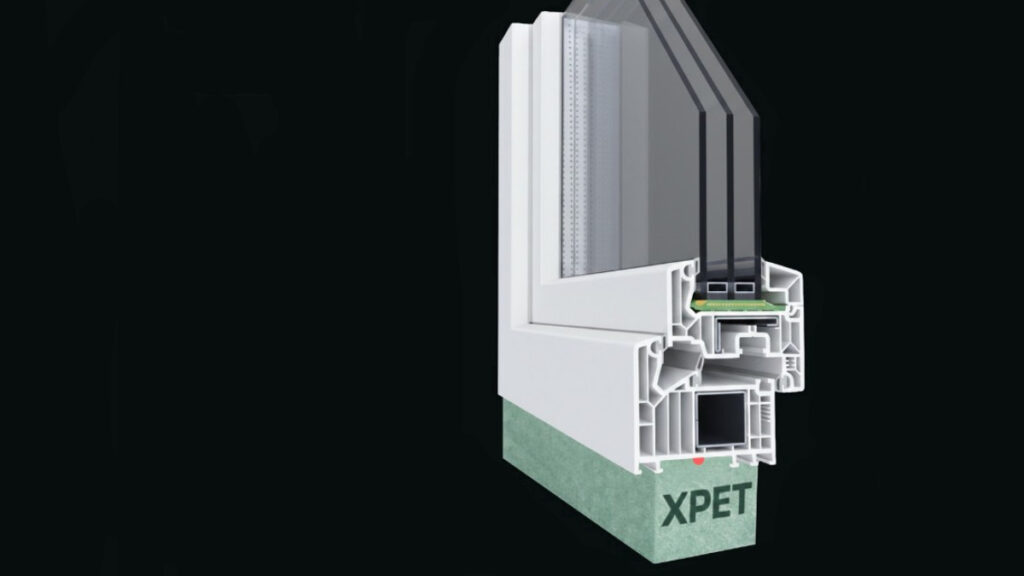
PET is a high-performance board material produced from recycled PET bottles. The finished board offers increased compressive strength, is practically non-absorbent to moisture, UV- and chemical-resistant, and at the same time is the lightest of the base profiles available on the market. Made from recycled plastic bottles, it achieves excellent thermal insulation properties and dimensional stability. In the context of window and door installation, PET base profiles are prefabricated elements used as a thermal support (base profile) for window frames and door thresholds. Their primary role is to ensure continuity of thermal insulation beneath the joinery and to transfer loads from the window or door structure in a durable, deformation-resistant way. XPET base profiles are available in various sizes and thicknesses and can be custom-milled for specific systems and architectural solutions. Their use significantly improves the quality of warm, airtight installation, minimizes thermal bridging and enables fast, precise installation of large windows and doors.Key benefits of PET base profiles
XPET base profiles are gaining popularity among investors who value energy efficiency and reliability. The main advantages include:- Excellent thermal insulation – the board’s thermal conductivity is typically around 0.03 W/mK, effectively reducing heat loss at critical junctions between the wall and the joinery.
- Resistant to moisture and mould – PET is essentially non-water-absorbing, with water absorption around 2%, does not rot, remains stable in harsh conditions and resists biological degradation.
- High mechanical strength – provides a durable support for heavy windows and doors without risk of deformation or cracking. It withstands loads of about 2.6 N/mm2, allowing installation of even the heaviest market constructions.
- Easy processing and installation – can be easily cut, drilled and adapted to non-standard solutions.
- Seamless integration with warm installation systems – ensures airtightness and continuity of insulation around the entire window or door opening.
- Weather and chemical resistance – PET remains stable in both freezing and hot summer conditions.
Use of PET base profiles in warm installation
Warm installation of windows and doors is now standard in modern energy-efficient construction. Eliminating thermal bridges at the wall–joinery junction is key. XPET base profiles fit this concept perfectly, allowing a continuous layer of thermal insulation even in places especially prone to heat loss, such as door thresholds or lower window frames. Practice shows that installing joinery on PET base profiles greatly improves thermal and acoustic insulation, reduces the risk of freezing and condensation at threshold trims. This solution complies with requirements for passive and low-energy house designs.Thermal performance, thermal bridge prevention and energy efficiency
The thermal properties of PET base profiles translate into real heating cost reductions and increased occupant comfort. PET’s thermal conductivity is on average 0.03 W/mK – meaning the material effectively blocks the flow of cold and moisture. As a result, even at the junctions with the wall structure, so-called thermal bridges are prevented, which otherwise would lower the insulating performance of even the best windows or doors. Using PET base profiles can reduce heat loss through the assembly by tens of percent compared with traditional solutions (e.g. foam concrete, clinker, rigid expanded polystyrene). This leads to lower energy bills, longer lifespan of windows and doors, and reduced risk of moisture damage or mould around the joinery.Practical aspects of installation and processing
One of PET’s greatest advantages is its ease of adaptation to various mounting systems. The material can be precisely cut by hand or machine to required shapes and sizes, both standard and bespoke. PET base profiles work well with adhesives and mounting foams, as well as screws or anchors, enabling secure fixing of windows or doors without compromising thermal insulation properties. During installation, particular attention should be paid to the connections between the base profile, the wall and the window frame to ensure full airtightness and insulation continuity, preventing air or moisture ingress. It’s also good practice to use vapor-tight and vapor-permeable tapes in accordance with warm installation standards.Comparison with traditional base profiles and other technologies
Traditional solutions under windows and doors—such as concrete blocks, brick, foam concrete or PUR-based base profiles—have limited strength, low moisture resistance or insufficient thermal properties and are very heavy. Compared to them, PET base profiles offer:- Significantly better dimensional stability over long-term use.
- No moisture absorption and no risk of biological degradation.
- Much better thermal insulation, preventing thermal bridges.
- Ability to be customised to any project and installation method.
- Faster and cleaner installation compared with traditional masonry, casting or insulation topping methods.
Selection and customisation of PET base profiles
When choosing base profiles for windows and doors, it’s essential to match the PET type to the specific construction, the weight of the joinery and the expected conditions. Manufacturer XPET offers wide prefabrication options for base profiles to required dimensions, shapes and load capacities—for single-family homes, multi-family buildings and commercial projects.Durability, cost-effectiveness and long-term benefits
Thanks to high resistance to mechanical, biological and weather influences, PET base profiles offer many years of service life that conventional materials cannot match. Investing in this solution pays off through:- Lower heating costs and improved building energy efficiency
- No need for frequent repairs of thresholds or lower window parts
- Trouble-free operation for decades
- Increased property value thanks to modern solutions meeting current market requirements