
- Why furniture makers look for alternatives to MDF and particleboard
- What the Kerdyn Green PET board is and how it differs from traditional furniture boards
- Worktops using Kerdyn Green PET board
- Modular furniture made from Kerdyn Green
- Cabinets and furniture carcasses made from PET board
- Conclusion – when Kerdyn Green makes sense in furniture
1. Why furniture makers look for alternatives to MDF and particleboard
MDF and particleboard are the most commonly used materials in furniture production, but they have clear limitations. This is especially visible in kitchen, bathroom, technical furniture and heavy-use installations.
The main issue is moisture resistance. MDF and particleboard absorb water, which leads to swelling, loss of stiffness and permanent damage. For worktops and cabinet carcasses this requires additional protection that raises costs and complicates manufacturing.
A second limitation is durability of furniture connections. Traditional boards tolerate repeated assembly and disassembly poorly. In modular and system furniture this causes loosening, screw pull-out and reduced structural stability.
Weight also matters. Worktops and carcasses made from MDF are heavy, which complicates installation, transport and use in mobile furniture, camper conversions and specialist builds.
An additional problem is dimensional stability. Changes in humidity and temperature make these materials move, affecting precision and durability of joints.
For these reasons manufacturers increasingly look for alternatives to MDF and particleboard. Instead of more variants of classic boards, they choose construction materials that are moisture-resistant, lighter and more stable, such as PET boards. In that context Kerdyn Green is used as a core for worktops, carcasses and modular furniture where traditional boards fail to meet performance requirements.
2. What the Kerdyn Green PET board is and how it differs from traditional furniture boards
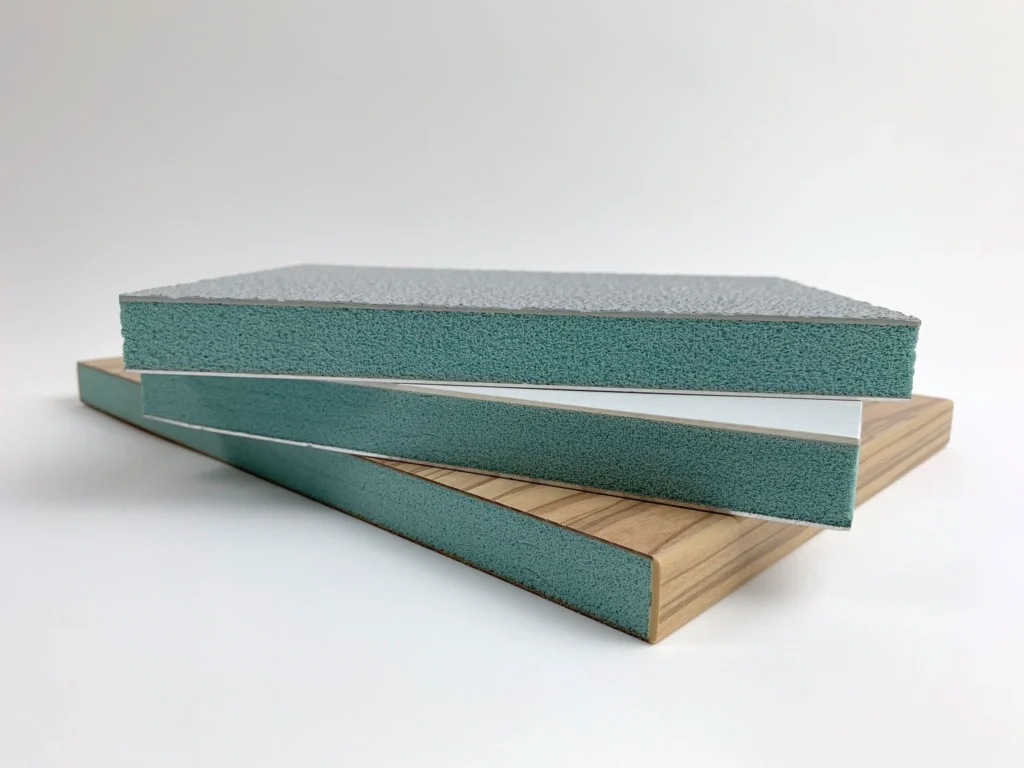
The Kerdyn Green PET board is a structural panel made from recycled PET, designed for applications that require high moisture resistance and dimensional stability. Unlike MDF and particleboard it is not wood-based but a technical plastic with a controlled internal structure.
A defining feature of Kerdyn Green is its uniform, closed-cell structure. The material has no layers of differing density and lacks absorbent pores. As a result the panel does not take on water, does not swell and retains its properties even with prolonged exposure to moisture.
Mechanically the PET board behaves differently than traditional furniture panels. It is lightweight yet compression-resistant, which allows its use as a structural core in worktops, carcasses and modular furniture. Its stability means the board holds dimensions and geometry regardless of changes in ambient temperature and humidity.
Kerdyn Green is also well suited to woodworking. It can be cut, routed and drilled with standard tools. With appropriate fasteners and assembly solutions the board provides durable, repeatable connections, especially in system constructions.
An important difference compared to MDF is that the PET board is not decorative. It is a technical material that typically serves as a core or structural element in furniture, while the visual finish is provided by laminates, veneers or decorative panels.
In summary, Kerdyn Green is not a visual substitute for MDF but a structural alternative where moisture resistance, low weight and stability are key. Those characteristics are why PET boards are increasingly specified in modern furniture solutions.
3. Worktops using Kerdyn Green PET board
In furniture production the Kerdyn Green PET board works very well as a core for worktops. It is not used as the wear surface but as the structural element responsible for stability, resistance and longevity of the top.
A typical worktop built with PET has a layered construction. The core is made from Kerdyn Green, while the top—and often the underside—is finished with a wear-resistant surface such as HPL, laminate, compact board or another abrasion-resistant material. This structure combines high mechanical resistance with any desired visual effect.
The biggest advantage is the moisture resistance. The PET core does not absorb water or swell, even if the top layer is damaged. In practice this means significantly greater durability for kitchen, laboratory and worktops compared with constructions based on MDF or particleboard.
Also important is the lower weight of the top. PET board is lighter than traditional wood-based panels, which eases installation, transport and use in mobile fittings, campers and modular furniture. At the same time the material carries both point loads and distributed pressure well.
Kerdyn Green also provides high dimensional stability. The worktop does not move with changes in humidity and temperature, which matters for long runs, corner joins and precise fitment of components.
Worktops with a PET core are used wherever classic solutions fail: heavy-duty kitchens, commercial back-of-house areas, laboratories, workshops and specialist furniture. This is a technical solution that truly improves longevity rather than just changing appearance.
4. Modular furniture made from Kerdyn Green
Modular furniture places much higher demands on structural materials than fixed installations. Components are often moved, disassembled, reconfigured and reassembled. In those conditions Kerdyn Green PET performs better than traditional furniture boards.
One key advantage in modular furniture is the low weight while maintaining stiffness. Modules made from Kerdyn Green are easier to transport and assemble, which is important for display systems, office furniture, mobile installations and temporary solutions.
The material shows good resistance to repeated fastening. With the right choice of screws or mechanical fittings the board holds joint integrity, reducing loosening and loss of rigidity. This is a significant benefit compared to MDF and particleboard.
PET board is also resistant to moisture and variable operating conditions, so modular furniture can be used in higher-humidity rooms and mobile installations where conditions fluctuate.
An additional asset is dimensional stability. Modular elements made from Kerdyn Green retain their dimensions, which simplifies precise alignment and later expansion of the system with additional modules.
In practice PET board is used in modular furniture as a structural material for carcasses, shelves and load-bearing parts, while the aesthetic layer is provided by veneers, laminates or decorative panels. This approach combines technical durability with total freedom of appearance for the final piece.
5. Cabinets and furniture carcasses made from PET board
The Kerdyn Green PET board works very well for cabinetry and furniture carcasses, especially where moisture resistance and long-term durability matter. Unlike MDF and particleboard the material does not swell or lose stiffness even under demanding conditions.
Cabinets made from PET board are lighter, stable and moisture-resistant, making them ideal for kitchens, bathrooms, laundries, commercial kitchens and technical rooms. This solution genuinely extends the service life of the furniture rather than just improving its look.
Kerdyn Green is used as the structural carcass, while the visible finish is achieved with doors, laminates or claddings. That way you keep full stylistic freedom while eliminating common problems of traditional furniture boards.
For manufacturers this means fewer complaints and a more durable product; for users it means furniture that withstands moisture and intensive use.
6. Summary
The Kerdyn Green PET board is not another variety of classic furniture panel but a structural material with a completely different profile. Thanks to moisture resistance, dimensional stability and low weight it is used where MDF and particleboard quickly reveal their limits.